
Addiction affects the whole family. Recovery should too.
By the time a family calls a rehabilitation centre, the patient is not the only person who needs help. SimranShri’s family therapy programme treats the system — the enabling, the confrontation, the exhaustion — alongside the patient’s addiction.
Confidential · No pressure · Available 24 hours · Government approved
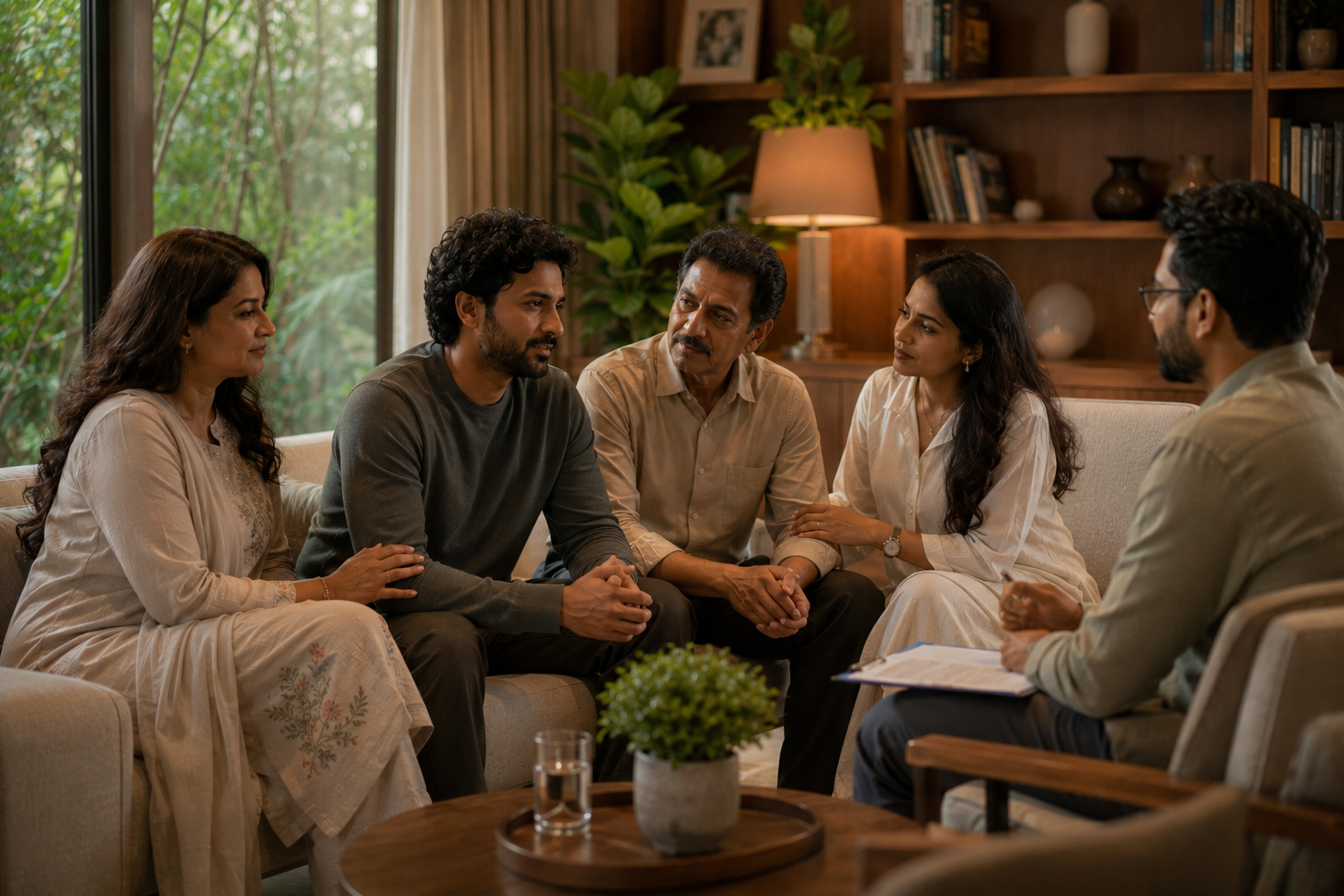
What is family therapy in addiction recovery?
Family therapy in addiction treatment is a structured clinical intervention that addresses the relational patterns surrounding a patient’s substance use. It is not generic counselling, not a “support group,” and not an optional add-on. It is an evidence-based part of the treatment that consistently produces better long-term outcomes than patient-only programmes.
Addiction does not develop in isolation. Over years, families adapt to a member’s substance use — often through a combination of enabling, confrontation, avoidance, and exhaustion. These patterns are functional in the short term (they keep the household operational) but destructive in the long term (they sustain the addiction and damage the relationships that would otherwise support recovery).
Our family therapy programme at SimranShri involves structured weekly sessions during the patient’s inpatient stay, continuing through the continued aftercare window. Sessions are led by a qualified psychologist and address: communication patterns, boundary-setting, enabling identification, confrontation without damage, and preparing the home environment for post-discharge stability.
Signs your family needs this programme
Every family affected by a member’s addiction develops predictable patterns. Recognising them is the first step toward changing them.
Enabling patterns
- Covering up consequences — at work, with family, socially
- Providing money that funds the substance
- Making excuses for behaviour caused by addiction
- Taking on responsibilities the patient has abandoned
- Avoiding conflict to keep the household “peaceful”
- Believing “this time will be different” after every relapse
Communication breakdown
- Conversations become confrontations within minutes
- Silent treatment for days after disagreements
- Secrets kept across generations of the family
- Children learning not to mention the substance
- Extended family excluded from the household’s reality
- Professional help framed as “airing dirty laundry”
Family-level exhaustion
- Caregiver burnout in the primary partner or parent
- Physical health issues in family members
- Marriages strained by years of addiction management
- Adult children carrying unprocessed childhood trauma
- Isolation from friends and extended family
- Financial instability from addiction-related costs
One or two patterns in isolation can be dismissed. Three or more, consistently, warrant a clinical conversation.
Who family therapy is for
Families arriving at SimranShri rarely look the same. Click a profile below — chances are you’ll see yourself in one of them.
The primary caregiver
You have managed the household around this person’s addiction for years. You are exhausted. You are carrying resentment, guilt, and fear. Family therapy helps you process that — and shift the patterns that kept you trapped.
How family therapy runs at SimranShri
Family therapy at SimranShri follows a clinical arc that parallels the patient’s treatment — not as a side-service, but as a co-equal pillar of recovery.
Initial family assessment
A family history session with the psychologist — relational patterns, enabling behaviours, prior interventions, current stressors. Informs the family-therapy plan.
Individual family member sessions
Primary caregivers and close family members meet individually with the psychologist to process their own experience, grief, and exhaustion before joint work begins.
Joint sessions begin
Patient and family meet together under the psychologist’s facilitation. Structured conversations that were impossible at home become possible in a clinical setting.
Discharge preparation
Written family communication guidance, boundary agreements, trigger-awareness for the home environment, post-discharge session schedule.
Post-discharge family support
Monthly family sessions continue through the continued aftercare window — in-person or remote depending on geography. Fast re-engagement if relapse occurs.
Evidence-based family therapy methods
Family therapy in addiction has decades of outcome research. The methods we use are the ones with the strongest evidence base.
Structural family therapy
Identifies the family’s relational structure — who holds power, who is peripheral, how communication flows — and helps the family consciously reshape it.
Behavioural Couples Therapy (BCT)
Strong evidence base for couples where one partner has an addiction. Focuses on daily communication, sobriety contracts, and rebuilding positive shared experiences.
CRAFT (Community Reinforcement and Family Training)
For families where the patient refuses treatment. Coaches family members on how to encourage treatment-seeking without confrontation.
Al-Anon / Nar-Anon integration
Peer-support resources for families, local to their home city, connected as part of the aftercare guidance.
Boundary-setting coaching
Concrete, situation-specific coaching for family members on how to maintain boundaries around money, behaviour, and responsibility.
Trauma-informed family work
Where the patient’s addiction has caused trauma in the family — particularly for children — we use trauma-informed approaches that acknowledge the impact honestly.
Relapse-planning for families
A written protocol for the family to follow if relapse occurs — what to do, what not to do, who to call. Not planning for failure; planning for resilience.
Why families choose our family therapy programme
Scheduled, not optional
Family therapy is built into every patient’s treatment schedule weekly — not offered as an add-on if the family asks.
Psychologist-led
Sessions are led by a qualified psychologist trained specifically in addiction family work — not a general counsellor.
Remote options for distant families
Families across Delhi NCR, UP, Rajasthan, and Punjab can attend sessions remotely when travel is impractical — recorded for patient/psychologist review afterward.
Extends into aftercare
Family therapy continues monthly through the continued aftercare window — when post-discharge stress is highest and relapse risk peaks.
What family therapy achieves
Families who engage actively in therapy see measurably better outcomes than families who do not. These numbers reflect the full integrated programme.
Family therapy runs for the duration of the patient’s residential stay (typically 45–90 days) with weekly sessions, and continues monthly throughout the continued aftercare window. Post-discharge, family sessions are scheduled alongside patient outpatient follow-ups — the family’s recovery arc is as long as the patient’s.
Before you call, here’s what most families want to know.
If your question isn’t here, call us. Our admissions team answers honestly, at any hour.
Addiction is a family disease — the enabling, confrontation, and avoidance patterns built up over years around a loved one’s substance use sustain the addiction. Family therapy addiction programmes consistently produce better long-term sobriety outcomes than patient-only treatment. At SimranShri, family therapy is a clinical requirement, not optional.
No. Family counselling rehab sessions at SimranShri are structured around whoever can realistically participate — primary caregivers, spouses, adult children, and close siblings. Forcing reluctant members to attend is counterproductive. We work with the family members who show up.
Yes. For families outside Delhi NCR — or when work and logistics make in-person attendance impossible — family therapy sessions can be delivered remotely via secure video. Recorded sessions allow patient and psychologist to review important moments afterward.
No. Family counselling at SimranShri runs weekly during the patient’s inpatient stay and continues monthly through the continued aftercare window. Post-discharge family sessions are critical — this is when relapse risk peaks and family dynamics most need support.
We offer CRAFT-based family work (Community Reinforcement and Family Training) specifically for families where the patient refuses addiction treatment. CRAFT coaches family members on how to encourage treatment-seeking behaviour without confrontation — and has strong evidence for success.
Sessions are led by a qualified psychologist and typically involve structured conversations between patient and family members — addressing communication patterns, enabling identification, boundary-setting, and post-discharge planning. Early sessions may be patient-only or family-only; joint sessions come later.
Individual counselling treats the patient’s psychology; family therapy addiction treatment treats the relationships surrounding the addiction. Both run in parallel. Many patients attend individual CBT sessions and family therapy sessions within the same week — different psychologists, different clinical focus.
Family therapy is confidential between the family and the psychologist — not shared with other patients or with anyone outside the clinical team. Early sessions are typically individual; families choose what to bring into joint sessions and at what pace.
Young children are generally not brought into joint therapy sessions, but their experience of a parent’s addiction is a core focus of family work. We help the affected parent rebuild a clear, honest, age-appropriate communication pattern with their children — this is often the most healing part of recovery.
Yes. Family therapy is part of our core addiction treatment programme at SimranShri — not a separate service. Inpatient family sessions and continued post-discharge family follow-up are included in the residential programme.
Continue exploring — adjacent treatment pathways.
You have done the hardest part— you started looking.Now let us help.
One confidential call. Our admissions team listens, assesses, and tells you — honestly — what family therapy for addiction at SimranShri would look like for your family.
Confidential · Government approved · 24×7