
How admission works — clear, private, and guided at every step.
Families call us from exactly one place: the moment home management has stopped working. What follows is not a sales process. It is a clinical pathway that begins with listening — and ends with a stabilised patient in structured treatment.
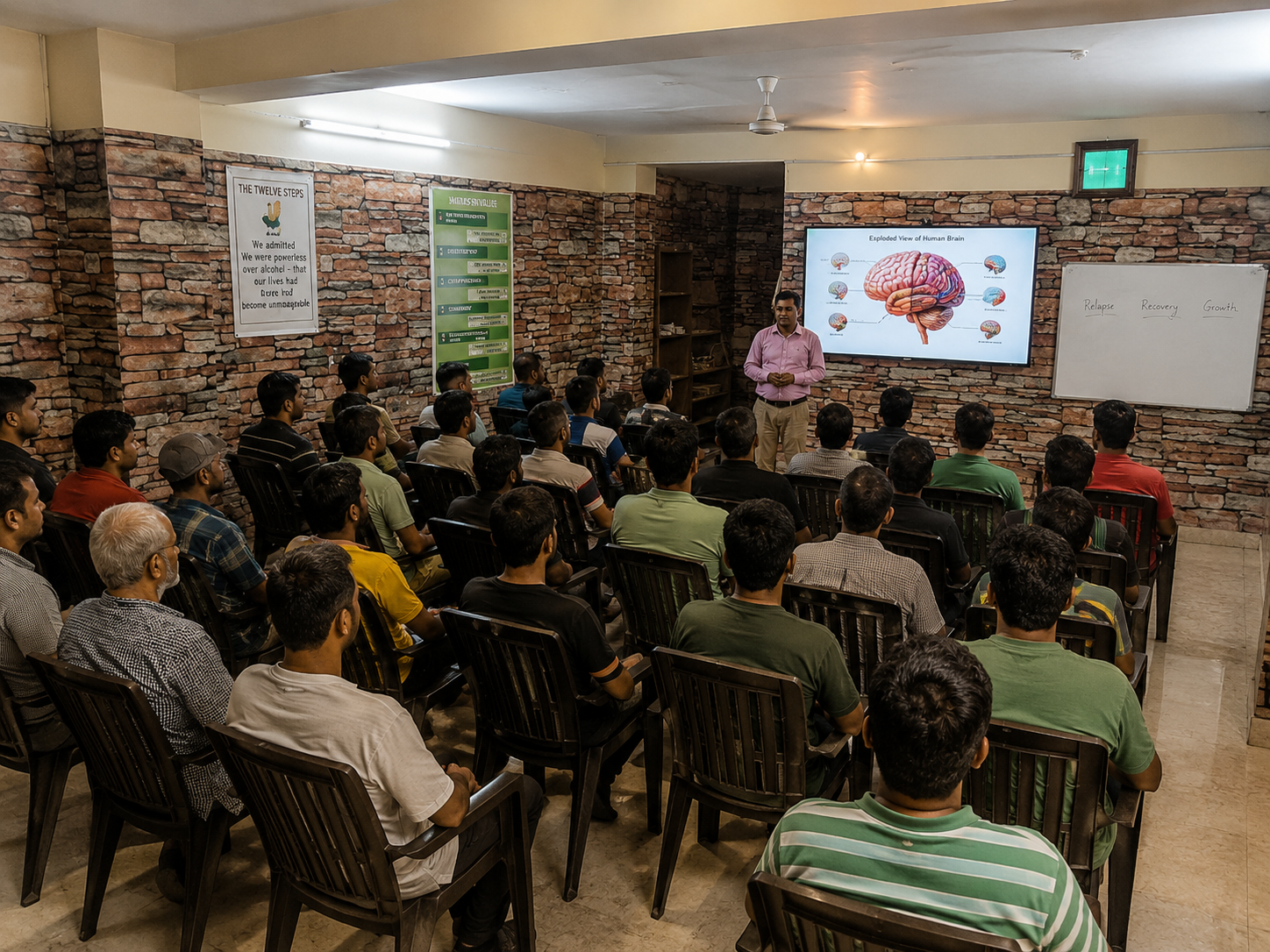
Four clinical steps. 24–48 hours start to admission.
From the first confidential call to the patient physically arriving at our Sector 92 facility, the typical arc runs 24–48 hours. Emergency admissions are faster.
One confidential call
You call the admissions desk at any hour — day or night. The counsellor who answers listens first. They gather basic context: the substance pattern, how long it has been going on, the urgency from your perspective, the patient’s current current condition, whether they are willing to admit voluntarily. The call is assessment, not sales.
Typical call length: 15–30 minutes. No pressure, no fees, no commitment.
Clinical assessment
Either by phone or in person, a qualified clinical team member conducts a full assessment — substance use history, withdrawal risk, co-occurring health conditions, psychiatric history, family context. The assessment determines which treatment pathway is clinically appropriate: inpatient, outpatient, or detox-first.
Typical duration: 45–60 minutes. Confidential. Produces the individualised treatment plan.
Planned admission
Our counsellors coordinate the practical logistics: pickup from your city, what the patient should bring, what the family should prepare at home, how communication will work during treatment, what Day 1 looks like, what the discharge timeline is expected to be. Admission itself is usually within 24–48 hours of the assessment.
Includes pickup across Delhi NCR · family orientation · Day-1 walkthrough.
Structured recovery begins
On Day 1 the patient arrives, receives a full clinical assessment on-site, meets the care coordinator, is introduced to the facility and the daily programme, and begins the stabilisation phase. The clinical team runs 24×7 during the acute window. Family members receive a first update within 24 hours.
withdrawal monitoring begins. Therapy introduced in structured stages. Family sessions scheduled.
A typical first day at SimranShri, hour by hour.
Arrival & admission paperwork
Patient is received by the care coordinator. Family completes admission documentation. Valuables catalogued and secured.
Full clinical assessment
On-site psychiatrist conducts the Clinical assessment. Vitals, bloodwork, toxicology, withdrawal-risk scoring. supportive care protocol planned.
Room orientation & facility tour
Patient shown their room, common areas, therapy spaces. Daily schedule introduced. Emergency protocols explained.
First meal & supportive care initiation
Structured meal with the resident community. Withdrawal supportive care begins where clinically indicated. Initial sleep protocol discussed.
Intake counselling session
First one-on-one with the assigned psychologist. Initial trigger mapping. Treatment plan reviewed with patient.
Rest & adjustment
Downtime. Patients generally find Day 1 emotionally heavy; rest is protected by protocol.
Evening meal & group introduction
Shared meal. Patient introduced to the resident community in a light, structured session. No pressure to share beyond comfort.
First family update call
Care coordinator calls the family with a Day-1 update: clinical status, admission complete, next family session scheduled.
What to bring — and what to leave at home.
- 3–5 sets of comfortable clothing (cotton preferred)
- Toiletries (toothbrush, basic personal care)
- Any prescription supportive care with labels + prescriptions
- care records, recent test reports if available
- List of contacts in case of emergency
- Copy of government ID (Aadhaar, passport, PAN)
- Small amount of cash for incidental expenses
- Comfortable footwear
- Alcohol, drugs, or any substances
- Sharp objects (razors, nail clippers — provided on-site)
- Mobile phone (structured phone access is scheduled)
- Laptops or tablets (during acute phase)
- Unstarted supportive care
- Valuables or expensive jewellery
- Food items (nutrition is clinically managed)
- Outside visitors or visitor gifts on Day 1
How families stay connected during treatment.
Phone restrictions during the acute phase are a clinical decision, not a policy of distance. Structured communication protocols keep families informed and involved throughout treatment.
Daily family updates
The care coordinator calls your primary family contact daily for the first week, then weekly thereafter. Updates cover clinical status, treatment engagement, and any concerns.
Scheduled patient calls
Patient phone access is structured — typically 15-minute calls with family, scheduled daily after the first week. Calls are not monitored but happen at designated times.
Weekly family therapy sessions
Structured family therapy sessions run weekly throughout the inpatient stay. In-person for nearby families (Delhi NCR, Ghaziabad, Faridabad), remote for distant cities.
Scheduled visits
Family visits are scheduled at treatment milestones — typically end of week 2, week 4, and around discharge. Visits happen during structured hours to protect the treatment environment.
3 to 6 months — how the duration is decided.
Duration is a clinical decision made during the admission assessment — not a pricing bracket chosen by the family. The framework below is how we think about it.
Appropriate for mild dependency, early-stage intervention, or stepping down from a longer programme. Generally paired with intensive outpatient aftercare.
The most common residential length for alcohol addiction. Covers detox, initial therapy phase, and early family integration. Suitable for moderate dependency.
Standard for drug dependency, poly-substance addiction, or patients with failed outpatient attempts. Full therapy arc plus family integration plus discharge planning.
For severe dependency, long-term use, co-occurring clinical complexity, or where the home environment requires significant restructuring before discharge.
Leave your number. We call within 15 minutes.
Tell us who you are, who needs help, and how soon. Our admissions counsellor calls back within 15 minutes — confidentially, no sales pressure.
For clinical emergencies or immediate admissions, skip the standard pathway.
Questions families ask before the first call.
If your question isn’t here, call us. Our admissions team answers honestly, at any hour.
Planned admissions typically happen within 24–48 hours after the initial confidential call and clinical assessment. Emergency admissions are facilitated same-day, including pickup coordination across Delhi NCR. Our admissions desk is staffed 24×7.
The first call is a structured clinical conversation, typically 15–30 minutes. The counsellor gathers context: substance pattern, urgency, health history, family situation, willingness to admit. There is no pressure, no fee, no commitment — the call itself is the first clinical step.
For planned admissions, yes — voluntary admission is the standard. For patients resistant to treatment, our counsellors coach families through structured intervention approaches, communication strategies, and identifying the right clinical moment to initiate admission. We work with families facing exactly this challenge daily.
Copy of government ID (Aadhaar, passport, or PAN), any existing care records or prescriptions, and basic contact information for the primary family member. Full admission paperwork is completed at the facility on Day 1.
Families generally accompany the patient at admission (especially for pickup arrangements) but do not stay through the Day-1 clinical procedures. The first formal family session is typically scheduled for the end of week 1 or early week 2, once the patient is clinically stabilised.
Phone access is restricted during the acute phase (typically weeks 1–2) to protect the clinical environment and reduce trigger exposure. Daily scheduled family calls are arranged by the care coordinator from the first week. Phone access is reintroduced in structured stages as treatment progresses.
Yes. Our admissions desk operates 24×7. Night and weekend admissions happen regularly — both planned and emergency. The pickup team, care team, and admissions counsellors are all on-call around the clock.
Yes. Every inquiry, assessment, admission record, and clinical conversation is strictly confidential. Patient and family information is never shared outside the clinical team without explicit written consent.
One confidential call.Everything else we handle.
Confidential · Government approved · 24×7