
The 12-step program — a proven framework for lasting recovery.
The 12-step framework — developed by Alcoholics Anonymous and extended to Narcotics Anonymous — has been the backbone of addiction recovery worldwide for 80+ years. At SimranShri, we integrate 12-step work into every residential programme and connect every discharged patient to meetings in their home city.
Confidential · No pressure · Available 24 hours · Government approved
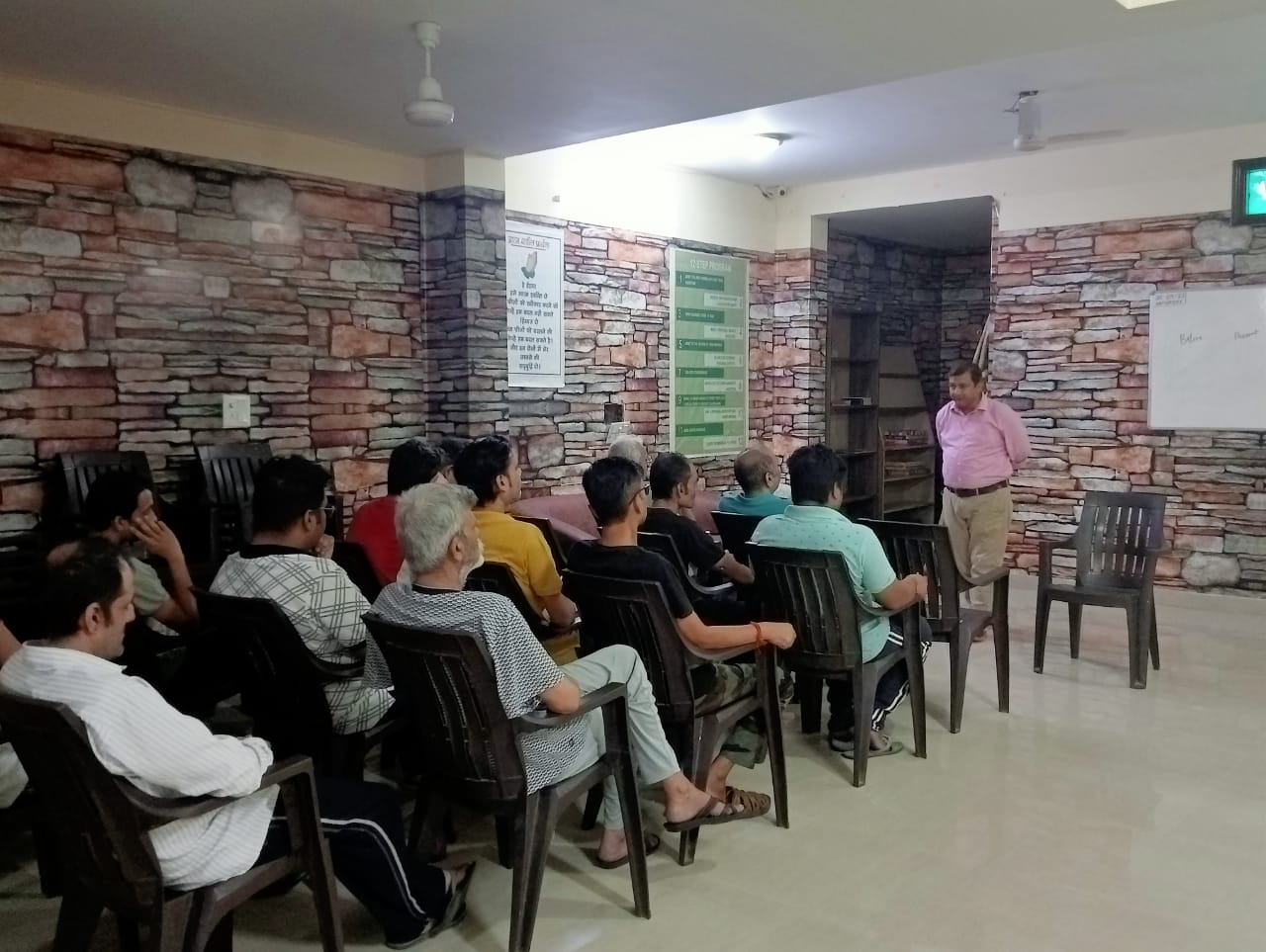
What is the 12-step program?
The 12-step program is a structured recovery framework originally developed by Alcoholics Anonymous in 1935 and extended to Narcotics Anonymous for drug addiction. It consists of twelve principles or “steps” that guide the recovering person through acknowledging the addiction, making amends for past harm, and building a new framework for daily living.
The 12-step framework is explicitly spiritual — though not religious — and it is peer-led rather than clinician-led. In meetings, people with addiction share experience with each other, supported by a “sponsor” (a more experienced member) who provides one-on-one guidance. Meetings happen daily in most cities worldwide and are free, anonymous, and open to anyone who wants to stop drinking or using.
At SimranShri, 12-step work is integrated into the residential programme alongside clinical treatment (CBT, withdrawal monitoring, family therapy). It is not a replacement for clinical supervision; it is a complement. Before discharge, every patient is connected to AA meetings (for alcohol addiction) or NA meetings (for drug addiction) local to their home city, with sponsor contact where possible. The peer-support framework continues long after the continued clinical aftercare ends.
When 12-step integration is especially valuable
The 12-step framework helps most recovering patients, but it is particularly valuable in the situations below.
After residential discharge
- Returning to environments where substance use is normalised
- Peer group still includes active users
- High-trigger home or work environment
- Long-term maintenance beyond clinical aftercare
- Need for ongoing community accountability
- Relapse warning signs emerging
For recurring relapse patterns
- Previous clinical treatment attempts worked temporarily
- Missing the peer accountability element
- Isolation during post-discharge recovery
- No sober peer group
- Limited structure outside of treatment facility
- Struggling with post-acute withdrawal
For long-term recovery
- Years of sobriety but wanting continued community
- Mentoring others entering recovery (sponsorship)
- Framework for ongoing life changes
- Support during life stress (loss, transitions)
- Spiritual or philosophical framework for recovery identity
- Connection with recovering community lifelong
One or two patterns in isolation can be dismissed. Three or more, consistently, warrant a clinical conversation.
Who benefits from 12-step integration
Families arriving at SimranShri rarely look the same. Click a profile below — chances are you’ll see yourself in one of them.
The recent-discharge patient
You have just finished residential treatment. Your structured daily environment is gone. AA or NA meetings provide an immediate daily structure — and a community of people who understand exactly what you are going through.
How 12-step integrates into treatment
12-step work runs alongside clinical treatment — not in sequence. Integration begins during residential care and extends indefinitely through peer-support community.
Introduction during detox
Early introduction to 12-step philosophy and language during the detox and stabilisation phase. No pressure; context-setting only.
Daily meetings in-programme
In-house 12-step meeting attendance becomes daily practice. Patients learn meeting format, step-study, sharing conventions.
Step work with sponsors
Patients begin formal step-work with an assigned in-programme sponsor — typically working through steps 1–3 during residential stay. Full step-work continues post-discharge.
Local meeting connection
Before discharge, the patient is connected to AA or NA meetings local to their home city. Preferred meeting times identified. Sponsor handoff where possible.
Lifelong engagement
Daily or weekly local meeting attendance. Continued sponsor engagement. Eventually sponsoring newer members. Recovery identity anchored in the 12-step community.
How we integrate 12-step in clinical treatment
The 12-step framework is peer-led, but clinical integration amplifies its effectiveness. Our methods bridge clinical and peer-support approaches.
AA integration for alcohol patients
Alcoholics Anonymous meeting structure, Big Book study, and step-work introduced during residential programme. Post-discharge, patients are connected to AA meetings in their home city.
NA integration for drug patients
Narcotics Anonymous equivalent — meeting structure, literature study, step-work. Post-discharge connection to local NA meetings.
Hospital & Institutions (H&I) visits
Volunteer AA/NA members visit the facility weekly to share experience with patients and model long-term recovery. Invaluable for patients who have never met someone with sustained sobriety.
Sponsor matching
In-programme sponsors assigned during residential stay. Post-discharge, we help match patients with local sponsors in their home city meetings.
Al-Anon and Nar-Anon for families
Family members are introduced to Al-Anon (alcohol) or Nar-Anon (drug) peer support — 12-step frameworks specifically for family members of addicts.
12-step + clinical integration
Clinical therapy (CBT, MI) and 12-step work run in parallel, each addressing different aspects of recovery. Neither replaces the other; both complement.
Online meeting access
Where patients are in cities with limited in-person meetings, we connect them to online AA and NA meetings — meeting coverage now spans Delhi NCR and most Indian cities.
Why 12-step integration at SimranShri works
Integrated from day one
12-step is introduced during residential treatment, not as an afterthought at discharge. By discharge, patients are already familiar with meeting format and step-work.
Sponsors arranged before discharge
We do not just hand patients a meeting list at discharge — we arrange sponsor connections where possible, because entering meetings alone is one of the biggest barriers.
Delhi NCR meeting network
Our admissions and aftercare teams know AA and NA meeting structures across Delhi NCR, UP, Rajasthan, Haryana, and Uttarakhand — we can direct patients to the right meetings in their home city.
Clinical + peer-support combined
Clinical therapy and 12-step work together produce substantially better outcomes than either alone. Our programme integrates both.
What 12-step engagement achieves
AA and NA engagement correlates strongly with long-term sobriety. Our outcomes reflect the combined clinical + peer-support programme.
Clinical aftercare runs after discharge. AA and NA engagement, by contrast, is designed for lifelong participation — weekly meetings, continued step-work, eventual sponsorship of newer members. Long-term sustained sobriety consistently correlates with continued 12-step engagement beyond the clinical-aftercare window.
Before you call, here’s what most families want to know.
If your question isn’t here, call us. Our admissions team answers honestly, at any hour.
The 12-step program is spiritual but not religious. It refers to a “higher power” which members define for themselves — God, nature, the community, the universe, or abstract concepts. Members of every religion and of no religion participate in AA and NA meetings worldwide. Our 12 step program addiction india integration respects whatever framework the patient brings.
The 12-step framework is integrated into daily residential programme structure — introductory sessions during week 1, daily meeting format from week 2, step-work with sponsors from week 4. Before discharge, patients are connected to AA or NA meetings local to their home city.
AA (Alcoholics Anonymous) is the 12-step framework for alcohol addiction specifically. NA (Narcotics Anonymous) is the equivalent for drug addiction — same 12 steps, adapted for drug-specific recovery context. Our aa na program delhi ncr integration connects patients to whichever is appropriate.
Clinical treatment without peer support is less effective long-term than clinical treatment plus peer support. We strongly recommend 12-step engagement for every discharged patient, but we do not force it. Some patients engage deeply; some attend occasionally; some do not engage at all. Clinical outcomes differ accordingly.
Yes. AA meetings operate in every major Indian city including Delhi, Noida, Mumbai, Bangalore, Jaipur, Chandigarh, Lucknow, and Kolkata. NA meetings are available in most metros and larger cities. Meeting schedules are available through national AA India and NA India websites. Our aftercare team helps identify the right meetings for each patient’s home city.
Typical meetings run 60–90 minutes. Format varies — step-study, speaker meetings, discussion meetings — but all involve attendees sharing their experience with addiction and recovery. Meetings are anonymous; what is said in the meeting stays in the meeting. Participation is voluntary.
A sponsor is a more experienced AA or NA member who provides one-on-one guidance through the 12 steps. Sponsors are peer mentors, not therapists. A sponsor relationship usually involves regular calls or meetings outside of group meetings. We help arrange sponsor connections before discharge.
Yes. Al-Anon (for family members of alcoholics) and Nar-Anon (for family members of addicts) are 12-step frameworks specifically for family members. Al-Anon and Nar-Anon meetings run in most Indian cities. We integrate family participation where appropriate.
Yes. AA and NA both have extensive online meeting networks. This is particularly valuable for patients in smaller cities with limited in-person meeting options, or for early-recovery patients who are not yet comfortable with in-person attendance.
AA and NA have 80+ years of observational outcome data. Large-scale studies consistently show that patients who engage actively with 12-step meetings have better long-term sobriety outcomes than patients who do not. While the 12-step framework differs methodologically from clinical trials, the outcome evidence for engaged participation is substantial.
Continue exploring — adjacent treatment pathways.
You have done the hardest part— you started looking.Now let us help.
One confidential call. Our admissions team listens, assesses, and tells you — honestly — what 12-step program at SimranShri would look like for your family.
Confidential · Government approved · 24×7